-
-
mill
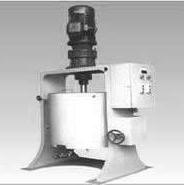
Acquisition of license to manufacture batch mills A special agitator shaft with symmetrically arranged agitator pegs and sleeves of tungsten carbide for wear protection devel- Vertical, batch operation mill for the preparation of tungsten Ideal flow behaviour due to a special agitator peg arrange-ment and the hemispherically
-

-
PRODUCT
Development of the first continuous agitator bead mill Product inlet via rotor / immersion tube system prevents back flow of grinding media into the feed line.
-
-
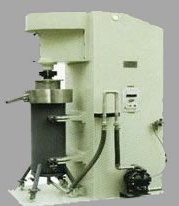
Development of the first continuous agitator bead mill
Product inlet via rotor / immersion tube system prevents back flow of grinding media into the feed line.
-
-
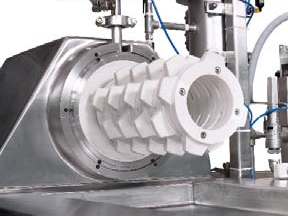
Ceramic comminution chamber technology
In 2015, we developed the first zirconia comminution chamber technology in China. It has no metal ion pollution and is used in batteries, pharmaceuticals, glazes, ink and food.
-
-
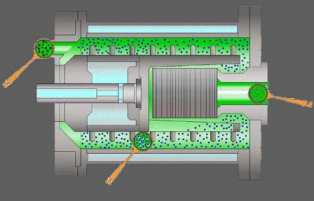
Rod-pin nano-grinding Technology
The grinding system pin nanomill shows the evolutionary develop- ment of system with the rotor-slotted pipe separating system. The enclosed horizontal agitator mill is designed for highest product throughput rates and possesses a pin grinding system for highest grinding intensity.
-

-
Horizontal Disk Grinding Machines
The Development In 2019, the first vertical agitator was developed internationally, the first horizontal agitator was developed in 1975, the first horizontal agitator bead mill with eccentric disks was introduced to the public and the horizontal disc grinder was introduced, in 2004, which became the industry standard. In the following years, the grinding media separation systems, the geometry of the grinding disks and the various grinding chamber materials were further developed.

 Visit Us: